GraphQL
A query language for APIs where the client specifies exactly what data it wants, and a single request can pull from many backends. This note starts from the basics and builds up to federation — the way large orgs (Netflix, etc.) run one graph across many independently-owned services.
What is GraphQL, and why does it exist?
GraphQL came out of Facebook (2012, open-sourced 2015). The problem it targeted: their mobile apps were making many REST calls to paint a single screen, over slow, unreliable mobile networks — and each call returned more data than the screen needed. Two classic pains of REST:
- Under-fetching — one endpoint doesn’t have everything a screen needs, so the client makes several round-trips and stitches the results together.
- Over-fetching — an endpoint returns a fixed payload, usually more fields than this particular screen uses. Wasted bytes on the wire.
Picture a Netflix-style home screen with three sections — profile, top shows, recommendations — each owned by a different service:
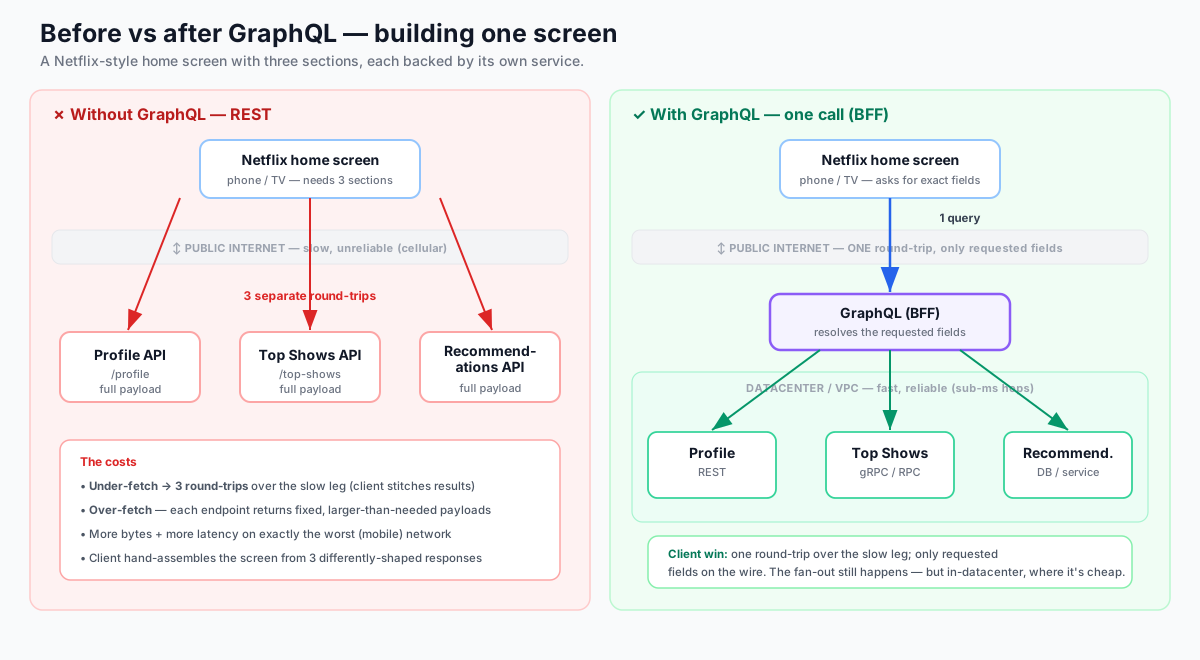
Left: 3 round-trips over the slow leg, each over-fetching. Right: 1 request for exactly the fields needed; the fan-out moves inside the datacenter.
With GraphQL, the client sends one request for exactly the fields it needs. Behind the scenes, GraphQL acts as a backend-for-frontend (BFF): to fill those fields it still has to fetch the data — a REST call here, an RPC call there, a database read — but those calls happen inside your datacenter / VPC, where hops are fast and reliable (sub-millisecond), not over the public internet.
That’s the core win:
The expensive, unreliable network leg (client → server) is crossed once, carrying only the requested fields. The fan-out to many backends still happens, but on the fast internal network. Fewer round-trips + less data on the wire = quicker page loads and lower latency, especially on flaky mobile connections.
Who uses it, and when it fits
- Where it shines: client-facing apps that assemble a screen from many backends and run on varied clients (phone, TV, web) with different data needs — Facebook, Netflix, GitHub, Shopify. A flexible, precise aggregation layer is exactly the job.
- Where it’s overkill: a simple CRUD service with one consumer and one data source — plain REST is simpler. GraphQL earns its keep when aggregation and client flexibility matter.
Fundamentals
Core operations
A GraphQL schema has up to three root entry points — ordinary object types GraphQL treats specially:
1. Queries (read) — fetch data; the equivalent of REST GET. Read-only: they retrieve data
and don’t modify server state.
query GetUser($id: ID!) {
  user(id: $id) {
    name
    email
  }
}
2. Mutations (write) — create / update / delete; the equivalent of REST POST/PUT/PATCH/
DELETE. They change server-side state. Unlike query fields (which execute in parallel),
mutation fields execute sequentially to avoid race conditions.
mutation UpdateUserName($id: ID!, $newName: String!) {
  updateUser(id: $id, name: $newName) {
    id
    name
  }
}
3. Subscriptions (real-time) — the server pushes updates to connected clients when an event occurs. Instead of the request-response cycle, a subscription holds a long-lived, persistent connection (usually WebSockets): the client “listens,” and the server pushes the payload when the event triggers.
subscription OnUserCreated {
  userCreated {
    id
    name
  }
}
The type system
First, what a schema file actually looks like — the contract, written in SDL (Schema
Definition Language): the Show and Person types, an enum, and a Query root with the
shows/show entry points:
"A movie or series in the catalog."
type Show {
  id: ID!               # ID! — required, opaque unique key
  title: String!        # String! — required text
  releaseYear: Int!
  kind: ShowKind!       # an enum (below)
  cast: [Person!]!      # a list of Person, never null, no null items
}

type Person {
  id: ID!
  name: String!
}

"A one-off movie or an episodic series."
enum ShowKind {
  MOVIE
  SERIES
}

# The Query root: the read entry points a client can ask for.
type Query {
  shows: [Show!]!        # all shows
  show(id: ID!): Show    # one show by id (nullable — the lookup may miss)
}
A client picks fields off that schema, and the response mirrors the query’s shape — containing only the fields asked for:
query {
  shows {
    cast { name }
    title
  }
}{
"data": {
"shows": [
{
"cast": [{ "name": "Millie Bobby Brown" }, { "name": "David Harbour" }],
"title": "Stranger Things"
},
{
"cast": [{ "name": "Robert De Niro" }, { "name": "Al Pacino" }],
"title": "The Irishman"
}
// …one entry per show
]
}
}Here’s that example in a playground (Apollo Sandbox):
![Apollo Sandbox playground at localhost:4001: left pane shows the schema Documentation explorer for the shows query and Show type fields (title, releaseYear, cast: [Person!]!); middle pane shows the query { shows { cast { name } title } }; right pane shows the JSON response listing each show’s cast and title, with 200/105ms/400B stats](/system-design-learnings/concepts/networking/graphql/apollo_graphql_playground.png)
Now the pieces of that schema, one kind at a time.
Mental model (the frame worth remembering): scalars & enums are leaves (actual
values — String, Int, ID, Boolean, Float, or an enum like ShowKind); objects
are branches you select sub-fields on (Show, Person); input types are the data going
in as arguments (you can’t pass a regular type as an argument — request DTOs use input);
and !/[] are modifiers layered on any of them. (Interfaces and unions exist too, for
polymorphic fields — reach for them when a field can return one of several types.)
To learn more, refer to the official GraphQL docs.
The part actually worth internalizing (the rest is lookup-able): nullability is a
contract — ! (non-null) and [] (list), which are modifiers separate from what kind a
type is. The list + non-null combinations each mean something different:
[Show]     # list may be null; items may be null
[Show!]    # list may be null; no null items inside
[Show!]!   # list never null (at least []), no null items   ← our `shows`
[Show]!    # list never null; but items may be null
Resolvers
A resolver is the function behind a field — it produces that field’s data. There’s one (conceptually) per field, and when a resolver returns an object, the resolvers for its fields run next — so resolving a query walks the tree from the root down.
Every resolver has access to the same things, whatever the language or framework:
- the parent — the object this field belongs to (what the resolver one level up returned).
- the arguments — what the client passed for this field (e.g. an
id). - a per-request context — shared state for the request (auth/user, DB handles, loaders).
There are two kinds: a top-level entry point (a Query/Mutation field) and a
field/computed resolver (a field on a type). The example below is JavaScript, but the
shape is universal — other stacks express the same thing differently (e.g. Netflix’s DGS
uses Java annotations like @DgsQuery / @DgsData, graphql-java uses DataFetchers):
const resolvers = {
  // 1. Top-level entry point: fetch the show matching the client's argument id
  Query: {
    show: (parent, args, context) => context.db.getShowById(args.id),
  },

  Show: {
    // 2. Field resolver: `parent` is the show the query returned; fetch its cast
    cast: (parent, args, context) => context.db.getCastForShow(parent.id),

    // 3. Computed resolver: no fetch — just derives a value from `parent`
    isReleased: (parent) => parent.releaseYear <= new Date().getFullYear(),
  },
};
Two ideas to hold onto:
- Resolvers are thin. A resolver delegates to a data source and returns plain data — it doesn’t hold business logic. And that source can be anything: a DB query, a REST call, a gRPC call. GraphQL doesn’t care (see “where GraphQL fits”).
- You only write the interesting ones. Fields with no explicit resolver use a default
resolver — just read the property of the same name off the parent. So
Show.titleneeds no code; you only write resolvers for entry points and fetched/computed fields likecast.
The N+1 problem
A single client query hitting a single service can explode into many downstream calls (gRPC / HTTP / SQL). Two multipliers stack:
1. Breadth — fields fan out to different backends. One Show may need several services;
each field’s resolver makes its own call. Take this query:
query {
  show(id: "1") {
    title          # from the catalog DB
    posterImage    # a URL, from an images REST service
    availability   # from a licensing gRPC service
    bingeScore     # from an ML ranking service
  }
}
Each field is resolved independently, and the source can differ per field — a DB read here, a gRPC call there, a REST call for another:
const resolvers = {
  Show: {
    // title needs no resolver — it's already on the show object (default resolver).
    posterImage:  (show, _args, ctx) => ctx.imagesApi.getPosterUrl(show.id),        // REST → URL
    availability: (show, _args, ctx) => ctx.licensingClient.getAvailability(show.id), // gRPC
    bingeScore:   (show, _args, ctx) => ctx.rankingClient.scoreFor(show.id),        // gRPC/ML
  },
};
This fan-out is expected — it’s the aggregation GraphQL exists to do (the client would’ve made these calls itself over REST anyway). The win: the client makes one request; the several backend calls happen server-side, in the datacenter.
Note — GraphQL returns a URL, not the image.
posterImageresolves to a string URL; the client then fetches the actual bytes from a CDN, out of band. GraphQL carries structured data and pointers to blobs — the blobs (images, video) travel over HTTP/CDN, never through the graph. (Same reason video streaming bypasses the graph — see the iceberg.)
2. Depth × cardinality — the N+1 problem (the dangerous one). A list field where a per-item resolver runs once per element:
query {
  shows(first: 20) {     # 1 call  → getShows(limit: 20)
    title
    cast { name }        # runs ONCE PER SHOW → 20 calls → getCastForShow(showId)
  }
}
# → 1 + 20 = 21 calls for what should be 2Why it happens
Concretely: a Show stores castIds: [42, 87] — just pointers — while the real person records
live elsewhere (a People service, or a separate cast table), because cast is shared across
thousands of titles. So resolving cast means a lookup per show.
- Across services or in one DB — same shape. With a naive ORM it’s
SELECT … FROM shows LIMIT 20(1 query), then a lazyshow.castfiringSELECT … WHERE show_id = ?per row (20 more). - Embedding avoids it, but has a cost. A
Showwould already contain its cast only if denormalized — which trades N+1 for data duplication, and you hit N+1 again the moment you ask for a field the embedded copy lacks (cast { awards }).
The fix: DataLoader
DataLoader is a generic utility to be used as part of your application’s data fetching layer to provide a consistent API over various backends and reduce requests to those backends via batching and caching. — DataLoader
Instead of each resolver fetching on its own, it hands its id to a loader with load(id). The
loader collects all the ids requested at nearly the same moment, makes one batched call
with the whole list, then gives each caller back its result.
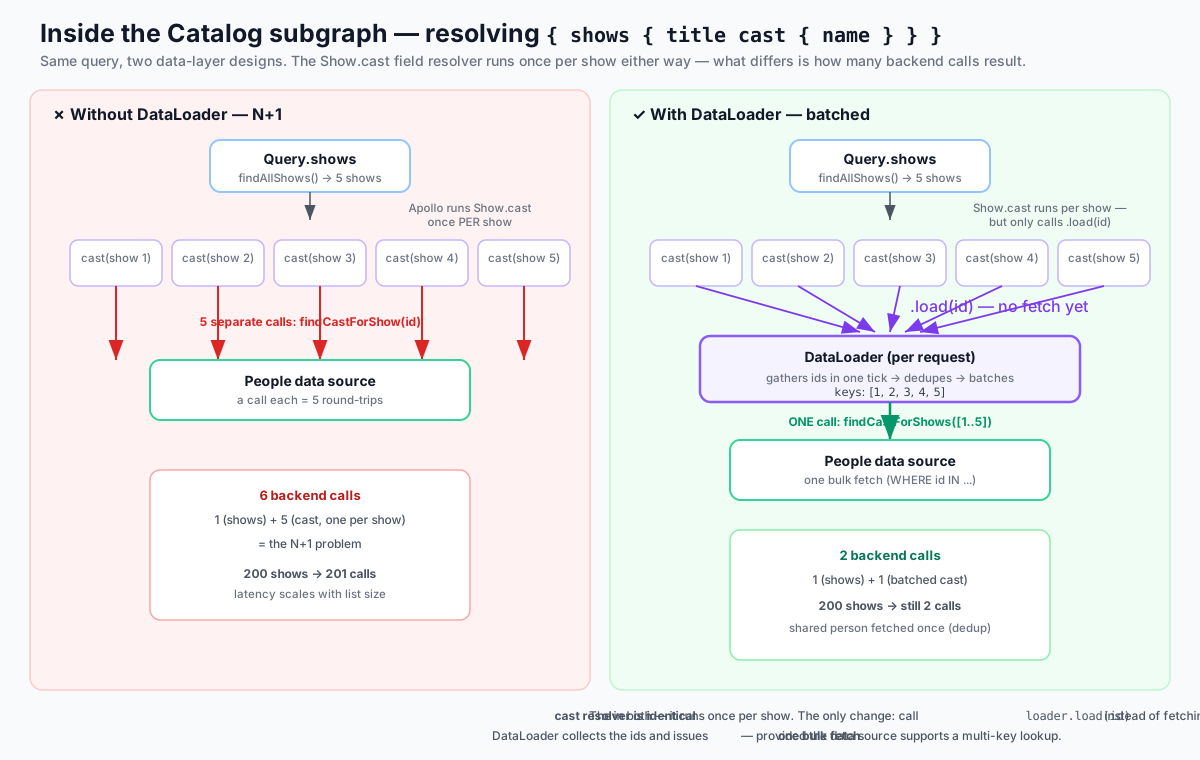
Left: the N+1 — one findCastForShow per show. Right: the same resolver calls loader.load(id), and DataLoader collapses them into one batched fetch (6 calls → 2).
cast resolver, show 1  → load("1")  ┐
cast resolver, show 2  → load("2")  │  collected together,
        ...                         ├─►  getCastForShows(["1".."20"])   ← ONE call
cast resolver, show 20 → load("20") ┘

21 calls → 2   (1 for the list of shows + 1 batched call for all their cast)
Two parts make it work, and you need both:
- The loader collects the ids for you — the resolvers stay simple (
load(id)), and the loader batches them behind the scenes. (In a single-threaded runtime like Node it gathers the ids within one event-loop tick; the mechanism differs per platform, but the idea is the same.) - You provide a batch function that does a genuine multi-key fetch —
WHERE id IN (...), a RedisMGET, aBatchGetRPC. If it secretly loops single fetches, you’ve batched the ids but not the calls — no win.
It also caches within the request, so a person appearing in two shows is fetched once. That cache is why a loader is created fresh per request — it should reset each request and never leak data between users.
If the source has no bulk endpoint, the N→1 collapse isn’t possible — the loader can’t batch calls a backend won’t accept together. Fall back to: get a batch endpoint added (best), lean on the dedup cache, cap concurrency to survive the fan-out, or cache responses across requests.
Another fix: joins
DataLoader isn’t the only answer. If the related data lives in the same database, you can JOIN instead of making a second fetch at all:
SELECT shows.*, cast.* FROM shows JOIN cast ON cast.show_id = shows.id; -- one query, no N+1One round-trip, no per-item calls. But joins have their own traps:
- Only works when co-located. If cast lives in a separate service, there’s no table to join against — you’re back to DataLoader over the network.
- Over-fetching by default. A resolver that always joins pulls cast even when the client
didn’t ask for it — wasted work on every query. The fix: inspect what the client actually
requested and join only when
castis in the query (“look-ahead”). Powerful, but couples the resolver to the query shape.
Rule of thumb: join when data is co-located; DataLoader when it’s spread across sources/services (the common case, and the only option once federated). Many resolvers use both. In JS, query builders / ORMs like Prisma, Knex, and Drizzle build these joins.
Catching it early
The trap: N+1 is invisible at small data sizes. With 3 shows it’s a handful of fast calls and feels fine; with 200 it’s 201 calls and your p99 latency falls over. So you want to catch it early:
- While writing code — the tell is a single-item fetch inside a list field (a
getCastForShow(id)called per show). Any field fetched from a separate source is a candidate. Many teams just require a DataLoader for every cross-source field as a rule, so it never ships. - At runtime — the clearest signals: tracing (one request shows the same
castcall repeated 20×), DB query logs (the same query 20× with different ids), or latency that grows with list size.
Defending the fan-out
Recall the core tradeoff: GraphQL relocates the fan-out from the client’s network to the server’s. That’s usually a win — but the complexity doesn’t vanish, so at scale these defenses aren’t optional:
- DataLoader — batch N+1 into one call (above).
- Depth / complexity limits — reject an exploding query before running it.
- Pagination — never unbounded lists.
- Per-backend timeouts — one slow downstream can’t hang the whole query.
Federation
So far we’ve pictured one GraphQL server. That’s fine for a small team — but a large consumer app like Netflix has dozens of teams contributing to its graph. As one giant GraphQL server, every team would edit the same schema and resolvers, constantly stepping on each other.
Federation splits the graph so each team owns and deploys their own slice, while the client still sends one query to one endpoint. That query travels over HTTP through the edge and an API gateway to a router, which owns the combined (“federated”) schema, figures out which services own which fields, fans the query out, and stitches the results into one response:
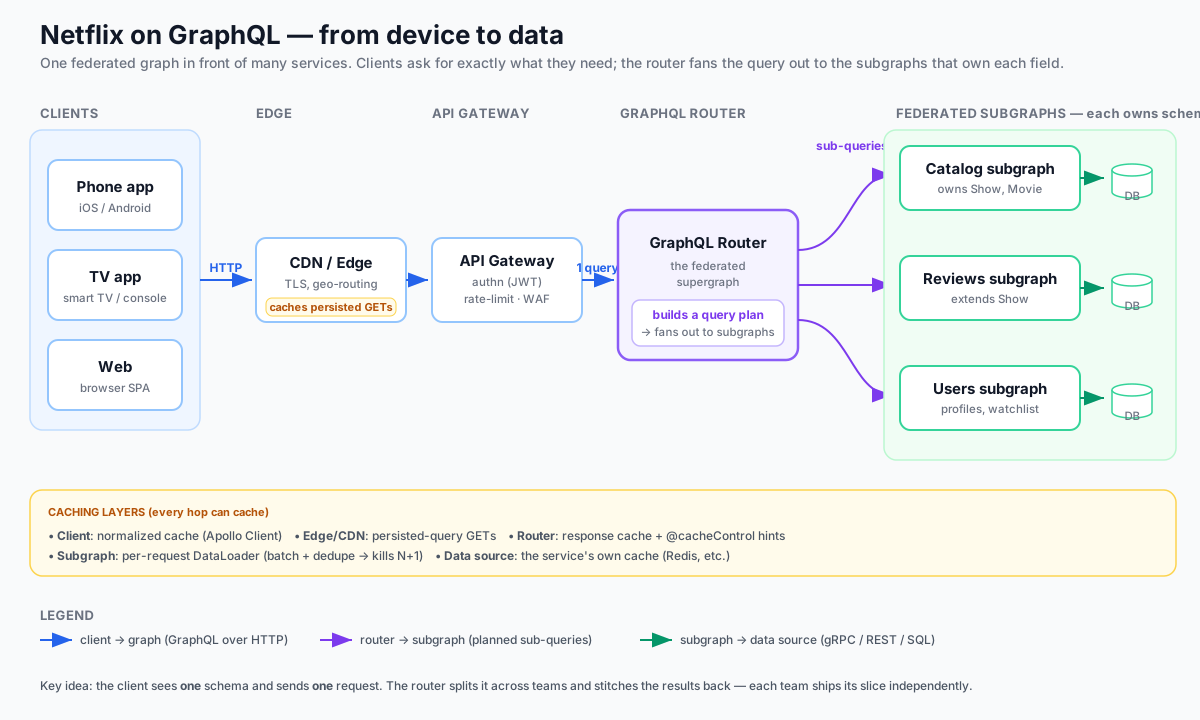
Each field is resolved by the team that owns it. GraphQL stays a composition / presentation layer — the real data lives in the services behind it (gRPC/REST + databases).
Three pieces make that up:
Subgraph — one team’s slice of the graph: a standalone GraphQL service that owns a domain
(Catalog owns Show, Reviews owns ratings, Users owns profiles), with its own schema, resolvers,
data, and deploy. A subgraph is a domain boundary, not necessarily one microservice — a domain
may sit atop several backing services, but it publishes one subgraph to the graph.
Supergraph — the single schema formed by composing all the subgraphs together (supergraph = composition of subgraphs). It’s the unified API the client sees; no client ever talks to a subgraph directly. Composition is driven by a config that lists the subgraphs and where they live:
subgraphs:
  catalog:
    routing_url: http://catalog:4001/graphql
    schema: { file: ./catalog.graphql }
  reviews:
    routing_url: http://reviews:4002/graphql
    schema: { file: ./reviews.graphql }
Router — the entity that sits in front, holds the composed supergraph, and does three things per request:
- Query planning — work out which subgraph(s) own the requested fields.
- Execution — call them in the right order (some calls depend on another’s result).
- Stitching — assemble the sub-responses into one clean result.
The client never sees any of this — one query to one endpoint, one response. The router’s own
runtime behavior (headers, auth, telemetry, limits) is configured separately, e.g. a
router.yaml.
The one hard part: letting one team’s type refer to another’s. Reviews wants to attach a
reviews field to a Show — but Catalog owns Show. Federation solves this with two ideas:
Federation = identity + ownership. Each type has an identity (a
@key— a field likeidthat uniquely identifies it) and an owner (the subgraph that defines it). Any other subgraph can then reference that type by its key and contribute fields to it.
A type with a @key is an entity — e.g. Show @key(fields: "id"). Entities are the shared
domain objects (Show, User) that multiple subgraphs attach fields to; the @key is the
handle that makes those cross-subgraph references possible. (The current standard is Apollo
Federation 2; Netflix builds this with its DGS framework.)
@key ≈ a primary key; a cross-subgraph reference ≈ a foreign key. The
relationship modeling is the same as a relational database — one side owns the identity, the
other refers to it by that identity. But two differences matter: (1) the “join” is a
distributed key-lookup across services (the router passes a reference { __typename, id }
to the owning subgraph, which hydrates it — closer to a BatchGet by key than an in-engine
JOIN), and (2) there’s no referential-integrity enforcement — a @key resolves
relationships, it doesn’t guarantee them (Reviews can hold a showId for a Show that Catalog
deleted). Cross-service integrity is the app’s problem, not the graph’s.Not everything becomes a subgraph
A natural question: does every service become a subgraph, and does all service-to-service traffic now route through the router? No on both counts. The dividing line for “should this be a subgraph?” isn’t client-facing vs internal — it’s does this own data/fields that belong in the client-facing graph? So the graph is a shallow aggregation layer: a handful of domains (Catalog, Reviews, Users, maybe Search) publish subgraphs; most services sit behind or beside them.
The router is a front door, not a service bus. It only splits a client query across the subgraphs that own the requested fields and stitches the results. Backend services still talk to each other directly — gRPC, REST, events — for everything that isn’t “a client asked for these fields”:
CLIENT-DRIVEN (through the router):        SERVICE-TO-SERVICE (direct, no router):
  client → router → Catalog subgraph         Playback ──gRPC──► Licensing
                 └→ Reviews subgraph          Recommendations ──gRPC──► Catalog
                                              Billing ──event──► Notifications
Routing internal calls through the router would add a latency + failure hop and couple every interaction to the router. So gRPC service-to-service traffic doesn’t go away — it stays peer-to-peer (mesh territory). A subgraph speaks GraphQL upward to the router, and often gRPC sideways to peer services and its own data.
The iceberg: what stays internal. The graph is a thin slice near the top; most services sit below it and never see a client query. For a Netflix-shaped app:
- Behind a subgraph (a resolver calls these): licensing / DRM, encoding/transcoding, personalization & ranking (ML), artwork.
- Never near the graph (own data planes): the CDN serving video bytes, playback/adaptive- bitrate control, the telemetry pipeline (billions of events), the ML training platform, billing, experimentation, fraud.
Some client paths bypass the graph entirely — video bytes come from the CDN (GraphQL only returns the manifest/URLs), and playback telemetry is fire-and-forget events. The graph is for structured, read-heavy, aggregation-shaped client data. Federation unifies the few client-facing domains without forcing the deep iceberg of internal services into one schema.
Resolving across subgraphs
So how does Reviews attach reviews to a Show it doesn’t own? When the router needs an
entity’s fields from another subgraph, it hands that subgraph a reference — just the type
name and key, { __typename: "Show", id }. The subgraph resolves that reference into an object
and its field resolvers fill in the fields it owns (reviews). Reviews never needs
the full Show — just the id — which is exactly why the @key matters.
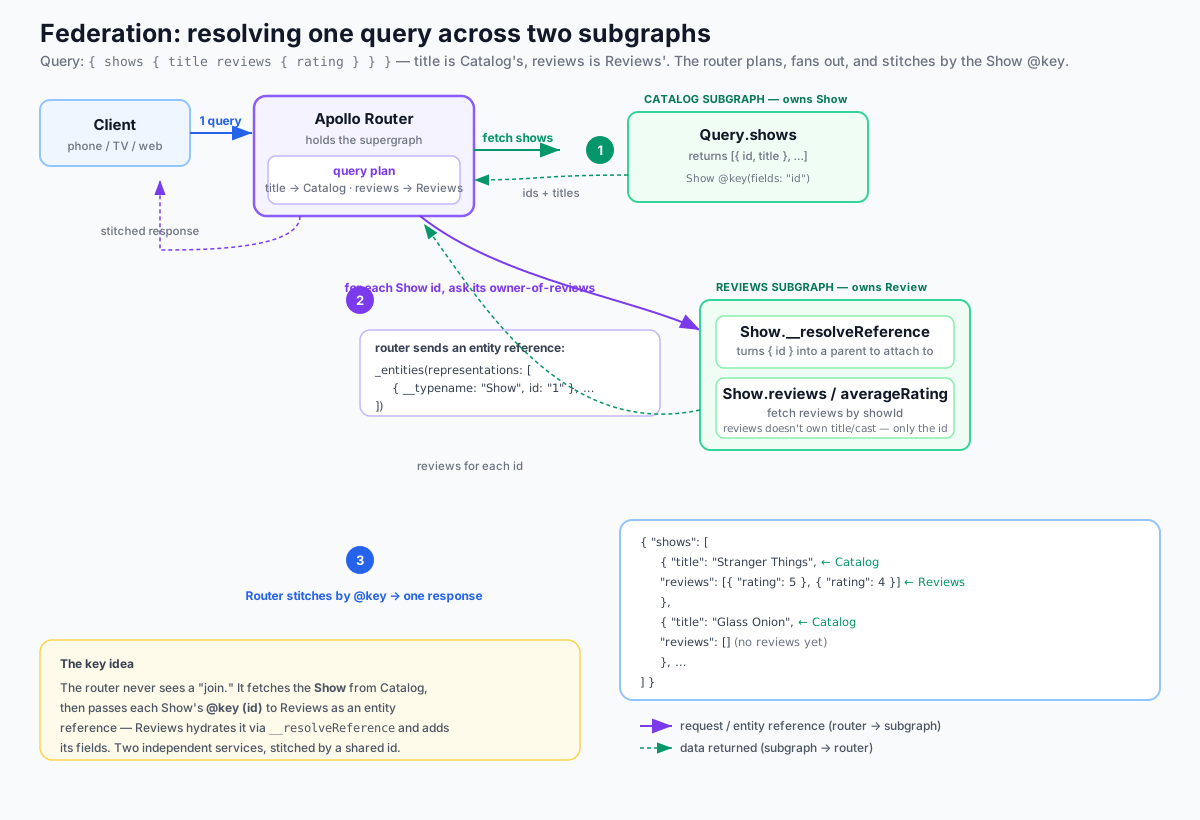
The router never does a “join” — it fetches Show from Catalog, passes each Show’s @key (id) to Reviews as an entity reference, and stitches the two services’ fields into one response.
Federation vs schema stitching
Before federation, the way to combine schemas was schema stitching: a gateway imported each service’s schema and you wrote glue code at the gateway to link types across services. The problem: that glue lived in the gateway, so the gateway had to know about every service’s internals — a central bottleneck that every team had to coordinate through.
Federation flips ownership. Each subgraph declares how its types extend others (
@key,@external) in its own schema; the gateway/router just composes those declarations — no hand-written stitching glue. Teams evolve their slice independently; the router doesn’t need bespoke per-service knowledge. That’s why federation superseded stitching for large multi-team graphs.
Composing the subgraphs into the supergraph happens at build time (via a schema registry + composition checks in CI): if one team’s change would break the combined schema — a broken cross-subgraph reference, an incompatible type — it’s caught before deploy, not at runtime. That build-time safety net is a big part of why federation scales to many teams.
Production concerns
The topics that separate “I built a GraphQL server” from “I run one at scale.”
Scalability
The router is where scale concentrates — and it’s designed for it:
- Built for throughput. The modern Apollo Router is written in Rust (replacing the older Node gateway) for high performance and low overhead on the hot path — it does query planning + fan-out for every request.
- Stateless → horizontal scale. The router holds no per-user state, so you run many
identical instances behind a load balancer and add more for more traffic. On Kubernetes
that’s just more replicas (a
Deployment+HorizontalPodAutoscaler). Handling billions of requests is just many router replicas fronting the subgraphs. - Subgraphs scale independently. Each subgraph is its own deployable with its own scaling profile; teams ship their slice without a monolith deploy, and the router composes the current set (service discovery points it at healthy instances).
Observability & telemetry
Because one client query fans out into many resolver/subgraph calls, you need to see inside a request. Distributed tracing (OpenTelemetry, Apollo traces) renders each request as a waterfall of spans — the fastest way to spot an N+1 (a resolver span repeated 20×), a slow subgraph, or a downstream timeout. Pair it with per-resolver metrics (latency, error rate, call counts) and structured logs.
Governance (field-level access)
(draft)
Once many consumers (client apps, internal tools) query one graph — especially with Personally
Identifiable Information (PII), compliance, and security in play — the question becomes: who is
allowed to read which field? And, critically, when a team adds a new (possibly sensitive) field,
it must not become blindly readable by everyone. (Most acute in a federated graph, where the
supergraph exposes every Type.field from every subgraph — but the pattern applies to any shared
API.)
Core idea: access is granted per (type, field) × consumer, default-deny, and each grant is an owner-approved request that doubles as the audit record.
- Per-field, not per-service — a consumer is granted specific fields (
Person.name), not “the People subgraph.” Per-consumer — each app has its own allowlist. - Default-deny. A field is unreadable until granted — even though it’s visible in the schema. Visibility ≠ authorization.
- Owner-approved & recorded. The request routes to the field’s owning team; each grant is tracked (requester, fields, approver, timestamp) — the workflow is the audit trail.
Why per-field + default-deny is the crux: because grants name specific fields, a new field starts with an empty allowlist — so adding one can never silently widen who reads data. If access were per-service, a new sensitive field would leak to every historical consumer by default.
Two distinctions worth keeping straight:
- Grant vs usage. The grant record answers “can this app ever read this field?” — not “did it, when, how often?” (that’s the telemetry above). Full auditability needs both.
- App-field vs per-subject auth. “Can this app read this field type?” is separate from “may this session see this customer’s row right now?” The latter is a contextual gate; the most sensitive fields may add encryption-scoped access on top.
The cost is real: every new field a consumer needs is an approval before shipping, which creates friction and risks rubber-stamping if owners are overloaded — good tooling and clear sensitivity tiers are what keep it bearable.
Other essentials
- Caching (multi-layer) — client normalized cache · CDN/edge · Automatic Persisted Queries (APQ) · router response cache · per-request DataLoader.
- Security — query depth / complexity limits, persisted-query safelisting, disabling introspection in prod, rate limiting.
- Schema evolution — additive-only changes;
@deprecatedfields instead of versioned URLs; composition checks block breaking changes. - Reliability — partial errors (
data+errors), per-subgraph timeouts/retries.
GraphQL vs REST vs gRPC
(comparison table — to be written) Short version: gRPC for internal service-to-service (binary, typed, fast); REST for simple public resources; GraphQL for a client-facing aggregation layer over many backends where clients need flexible, precise fetching. They compose — a GraphQL resolver often calls a gRPC service.
Talks & deeper resources
(cited by title/speaker/venue; verify the exact URL before relying on it)
- Official docs — graphql.org/learn (authoritative intro + full type reference) · Apollo Federation docs
- Netflix — How Netflix Scales its API with GraphQL Federation — Netflix Technology Blog. (verify)
- YouTube — Design Principles of Federated GraphQL — Martijn Walraven (Apollo), GraphQLConf 2024.
- YouTube — GraphQL Federation: The Architecture That Powers Netflix’s 70+ Microservices — ByteMonk.
- DataLoader — github.com/graphql/dataloader — the batching pattern, from Facebook.
Planned topics
- Pagination — offset vs cursor; the Relay connections spec (
edges/node/pageInfo). - Errors — partial success (
data+errors), error masking, and why HTTP is usually200. - Realtime — subscriptions (WebSocket / SSE); see the realtime family in networking for transport tradeoffs.
- GraphQL vs REST vs gRPC — full comparison table.
Quick self-check (recall from memory)
- What two REST problems does GraphQL target, and how does a single query address them?
- Client sends one query for a show’s title and its reviews — how does the router get both when two different teams own them?
- What exactly is the N+1 problem in a resolver, and how does DataLoader fix it?
- Why is a GraphQL resolver “thin”? What lives behind it in production?
- Federation vs schema stitching — what did federation change about where the glue lives?
- Why can the router scale horizontally, and what makes that possible?